Overview
This page presents the Context of Use Ontology (ContUsO): the conceptual model, the figure used in the specification, all main concepts, an instantiation example (Alex's case) and a short glossary of terms related to ContUsO.
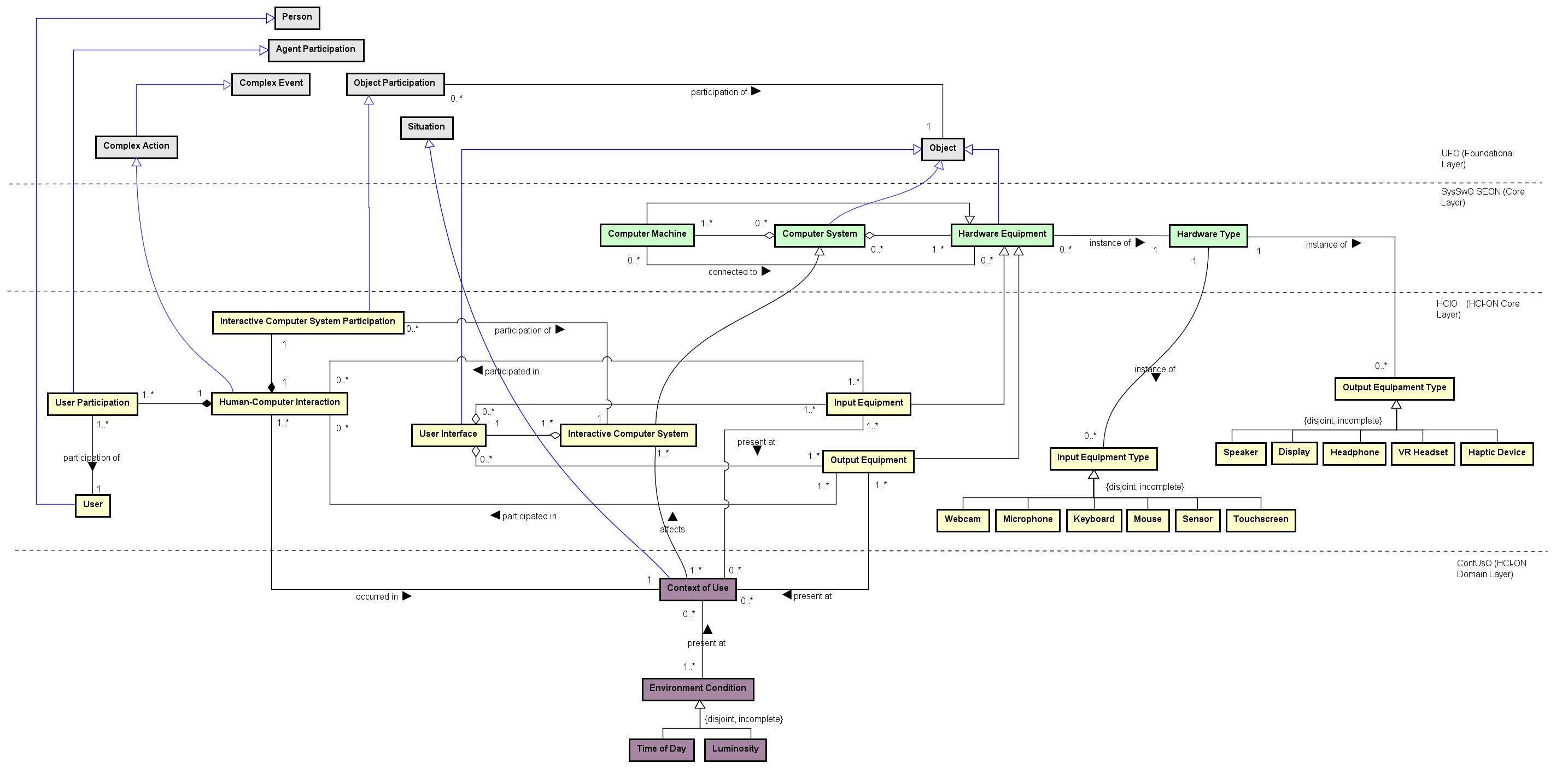
Conceptual model (figure)
 OObject
CSComputer System
HEHardware Equipment
UUser - Person participating in HCI
UPUser Participation
HCIHuman-Computer Interaction
ICSInteractive Computer System
ICSPInteractive Computer System Participation
UIUser Interface
IEInput Equipment
OEOutput Equipment
CoUContext of Use
EEnvironment
ECEnvironment Characteristic
ECTEnvironment Characteristic Type
OObject
CSComputer System
HEHardware Equipment
UUser - Person participating in HCI
UPUser Participation
HCIHuman-Computer Interaction
ICSInteractive Computer System
ICSPInteractive Computer System Participation
UIUser Interface
IEInput Equipment
OEOutput Equipment
CoUContext of Use
EEnvironment
ECEnvironment Characteristic
ECTEnvironment Characteristic Type
Figure: Context of Use Ontology (ContUsO). (Click image to enlarge - click hotspots to jump to concept)
Concepts (UFO - Foundational Layer)
- Agent Participation - Refers to the intentional involvement of an agent in an event. These are the intentional participations of agents, considered as actions. E.g.: a player's participation in a football match.
- Complex Action - A Complex Action is composed of two or more Participations. These participations can themselves be intentional (i.e., be themselves actions) or unintentional events. For @ex, the stabbing of Caesar by Brutus includes the intentional participation of Brutus and the unintentional. participation of Caesar and the knife. In a complex action, at least one participation should be intentional, i.e., an action contribution.
- Complex Event - Complex events are aggregations of at least two disjoint events. A Complex Event is existentially dependent on all its proper parts and, indirectly, to the objects these proper parts depend on.
- Endurant - Endurants are said to be wholly present whenever they are present, i.e., they are in time. They can be understood in contrast with the category of Perdurants (Processes, Events). Examples of endurants are a house, a person, the Moon, an amount of sand. For instance, we can say that an individual John weights 80kg at in circumstance c1 but 68kg at in circumstance c2. Nonetheless, we are in these two cases referring to the same individual.
- Event (Perdurant) - Events (also called perdurants) are individuals composed of temporal parts. They happen in time in the sense that they extend in time accumulating temporal parts. @Examples of events are a conversation, a football game, a symphony execution, a birthday party, or a particular business process.
- Mode - It represents an intrinsic and immeasurable characteristic of an individual, such as beliefs, skills, or thoughts, that cannot be quantified on a scale of values. E.g.: Alex's headache is a Mode, a property that exists only in Alex and cannot be measured or expressed in numerical terms.
- Mode Universal - It is an intrinsic universal moment that is not directly related to quality structures, that is, it denotes a non-measurable property. Its instances are called Modes, which are individual and non-qualitative properties that inhere in an Individual. Unlike qualities, modes cannot be represented in a quality structure or expressed in terms of measurable values. For example, Alex's headache is a Mode, a property that exists only in Alex and cannot be measured or expressed in numerical terms. Other examples of Universal Modes include Abilities, Beliefs, and Thoughts that have existential dependence on a single Individual.
- Object - Non-agentive substantial individuals. Objects can be Physical or Social.
- Object Participation - Object Participation is a set of different ways than an object can participate in actions. There are four different types of Object Participation, namely: Creation, Termination, Change and Usage.
- Person - A human Physical Agent. E.g.: Tim Berners Lee, Dennis Ritchie, Donald Knuth.
- Situation - A situation is a particular configuration of a part of reality which can be understood as a whole. Situations can be factual or counterfactual (@e.g., the situation in which “Al Gore is the president of the USA”).
- Substantial - Substantials (objects) are existentially-independent Endurants (@e.g., a person, a car).
- Time Point - It is a specific point in time, used to mark the beginning, the end, or an exact point within an event. i.e., it represents a precise moment, without duration, that serves as a temporal reference for the occurrence of events.
Concepts (SysSwO - Core Layer)
- Computer System - System containing one or more Computer Machines, and other Hardware Equipments connected to them, and associated software systems that are installed/loaded in these Machines (adapted from ISO/IEC/IEEE 24765:2017).
- Hardware Equipment - Physical Object used to process, transform, store, display or transmit information or data. E.g.: Computer Dell I7, Laser Printer HP, Smartphone Galaxy 7, Router Linksys Wi-fi.
Concepts (HCIO - Core Layer)
- Human-Computer Interaction - An interaction event composed by participations of User and Interactive Computer System.
- Input Equipment - Hardware used for input (e.g., keyboard, mouse, microphone, webcam) that is part of the User Interface and can be present at the Context of Use.
- Interactive Computer System - The computer system that participates in the interaction (may reuse SysSwO/HCIO concepts).
- Interactive Computer System Participation - The participation of an Interactive Computer System in a Human-Computer Interaction. E.g.: the participation of the mobile phone system in the human-computer interaction in which the user touches her finger to unlock her mobile phone by using her fingerprint and the mobile phone system shows a message informing that the fingerprint was not recognized; the participation of the smart watch in the human-computer interaction in which the user uses the smart watch to monitor her heart pulse.
- Output Equipment - Hardware used for output (e.g., display, speaker) that is part of the User Interface and can be present at the Context of Use.
- User - A Person who interacts with (or is expected to interact with) an Interactive Computer System.
- User Interface - All components (hardware/software) that provide information and controls for the user to accomplish tasks; Input/Output Equipment are parts of the User Interface.
- User Participation - Event in which the user participates in a Human-Computer Interaction. E.g.: user walking and unintentionally giving information about number of steps to a monitoring system loaded in her smart watch; user touching her finger to unlock her mobile phone by using her fingerprint; user interpreting a message from the mobile phone system informing that the captured fingerprint was not recognized.
Concepts (ContUsO - Domain Layer)
- Context of Use - The Situation in which a Human-Computer Interaction occurs; it captures environmental and situational factors that influence interaction.
- Environment - The physical/social place where the interaction occurs (e.g., home, office, public space).
- Environment Characteristic - A moment/unary quality that inheres in an Environment (it is an instance of Environment Characteristic Type).
- Environment Characteristic Type - Types such as Luminosity, Connectivity, Geographic Geolocation, Noisiness, and Time of Day.
Environment characteristic types (examples)
Environment Characteristic Types modeled in ContUsO (examples):
- Luminosity (e.g., low light, bright)
- Connectivity (e.g., fast, slow)
- Geographic Geolocation (e.g., home, office, public space)
- Noisiness (e.g., low, high)
- Time of Day (e.g., morning, night)
Instantiation example - Alex's case
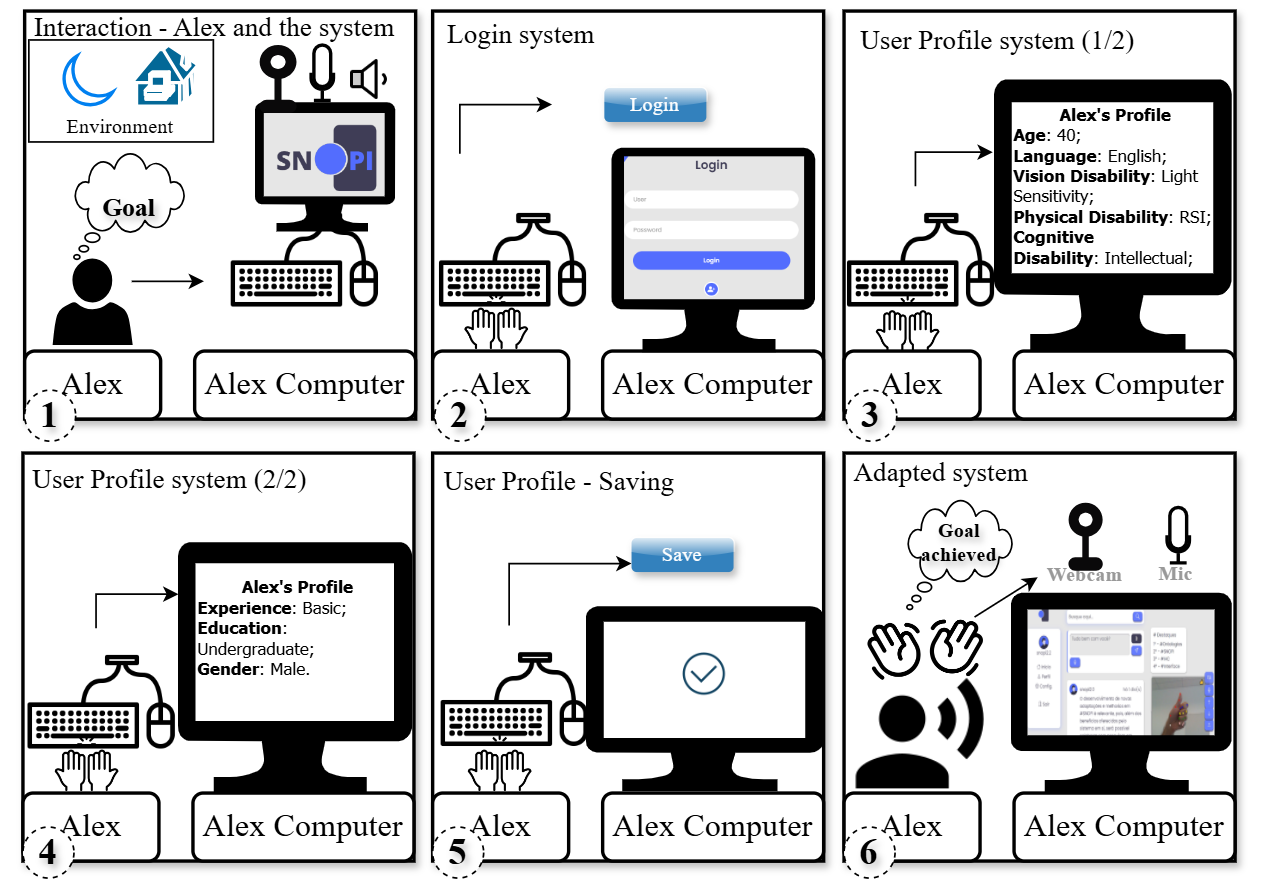
The following table shows the ContUsO instantiation extracted from the scenario used in the specification (Alex interacting with a social network system).
(Click to enlarge)
| Concept | Instance |
|---|---|
| User | Alex |
| Interactive Computer System | The social network about scientific events |
| Human-Computer Interaction | Interaction between Alex and the system |
| Input Equipment | Alex's keyboard, mouse, microphone, and webcam |
| Output Equipment | Alex's computer display and speaker |
| Environment | Alex's room |
| Environment Characteristic - Time of the Day | Night |
| Environment Characteristic - Luminosity | Low luminosity |
| Context of Use (summary) | Alex uses the system at night, in a room with low luminosity, using display, keyboard, webcam, microphone and speaker. |
The ontologies were modeled in UML (Unified Modeling Language), but a specific representation of powertypes - when specializations of a concept are instances of another concept of a higher order - does not exist in UML. Thus, we used an adaptation (dotted arrow), following the approach for UML-based ontological modeling proposed by Guizzardi (2005), which allows for the dual nature of specializations to be adequately represented as instances of a higher-order concept within the ontology.
